Sunday, May 5, 2013

Surgery recovery, loose ends, and Earth Tubes!

Over the last few weeks I've been focusing on some "loose ends" type projects around the farm while recovering from a minor surgery to repair an umbilical hernia.  My strength, physical ability, and energy level are pretty much back up to where they were beforehand, but for a while there I was putting around on impulse power.

So this is going to be a long post, fair warning!

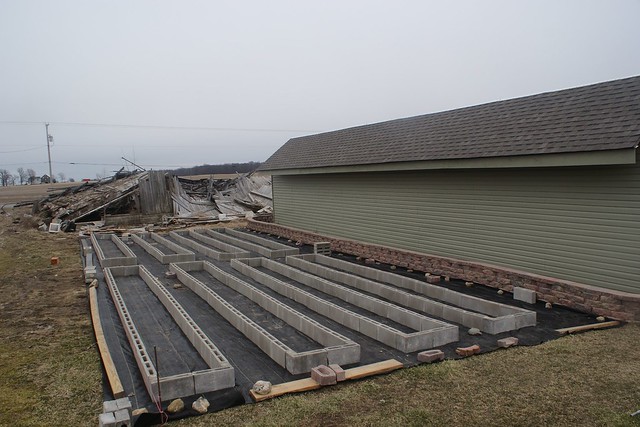
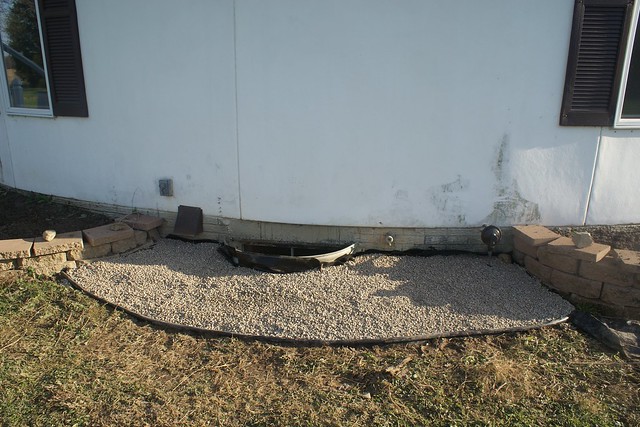
I spent the better part of a weekend a few weeks ago applying landscape fabric and pea gravel to the gap areas between sections of our circumn-housal (I totally just made that word up) raised beds.  Due to their shape and location they are notoriously hard to mow/trim, and as a result these areas annually became a nightmare tangle of odd and menacing volunteer plants (with a common itchy thread of poison ivy woven throughout).  So this year, while everything was still "down and brown" from winter, I decided to get proactive about it.

The results look pretty darn good, and will hopefully cut down on the amount of poison ivy we find trying to grow up the side of the house this fall (those would be the dark places along the house wall).


We spent a goodly amount of time last weekend working on the barn wreckage and putting up some more insulation panels in the greenhouse.  We are approaching the time of year when it's really only comfortable in the greenhouse in the morning before the sun really gets going, and in the evening after it's gone down.  So we'll be working in there on mornings and rainy days, and picking up whatever didn't get done in the fall.  Hopefully we can get it 100% shored up inside for this winter, where we can do a real test of what will and won't grow in there during the icy months.


This weekend found us working to install the "earth tubes" passive ventilation system on the greenhouse.  I had the idea for this while sealing up some small air leaks around the interior of the greenhouse, near the floor.  I noticed that the greenhouse was pulling cool air in through these small airspaces, presumably as a result of the heated air being pushed out the two gable vents near the top of the side walls.

So I began planning for a system that would take better advantage of this tendency, in a way that would passively provide some measure of cool air flowing through the greenhouse during periods of warmer weather.  It is essentially a set of two tubes that are buried beneath the entire earth mass of the raised bed along the shady north-facing side, and enter the greenhouse through the floor.

As convection pushes the hot air out the gable vents at the ends of the greenhouse, it should pull air through the tubes, cooling it as it passes beneath all the shaded soil (we may add a small solar-powered inline fan to increase draw through the tubes if needed).

In the winter we could limit or stop the air flow from within the greenhouse, to prevent pulling too much cold air in (buried no deeper than it is, the soil will be much less likely to provide any appreciable warming action on the cold air in winter).

I had never heard of Earth Tubes before, but in researching my newfound idea I learned that a similar system is frequently put into use in Earthships and other more holistically-designed homes.

In those circumstances, the systems are buried deep enough to provide cooling in the summer AND warming in the winter, but for our purposes we've got warming pretty much covered from the passive solar angle.

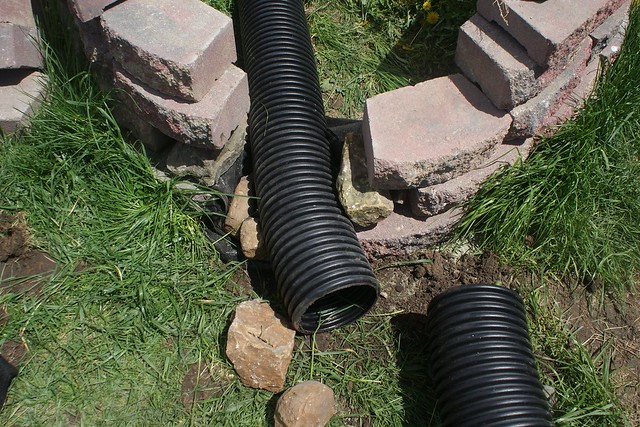
I'm still not sure to what extent it will work or how much air it will pull, but I'm pretty sure that it will provide some benefit, and it was relatively inexpensive to install (needing just a big-ass roll of HDPE drainage tubing, pictured above) and requires no major modifications to the greenhouse itself.

So I started digging!  First, one of two holes that burrows just under the north wall of the greenhouse.
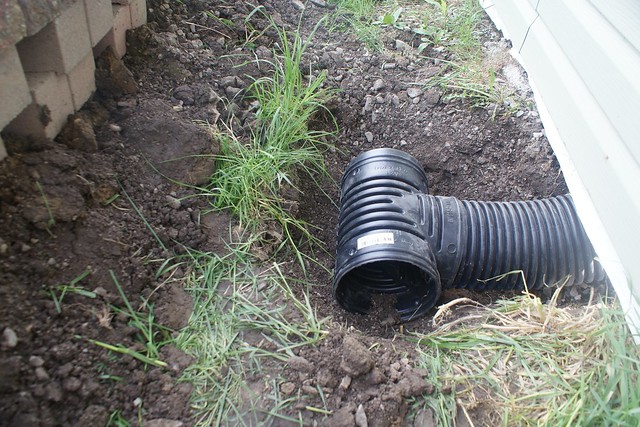


Here's the tube sticking up inside.  Once we finish putting up the second layer of insulation and the radiant heat barrier, we'll trim the pipe off closer to the floor and affix it to the wall somehow.
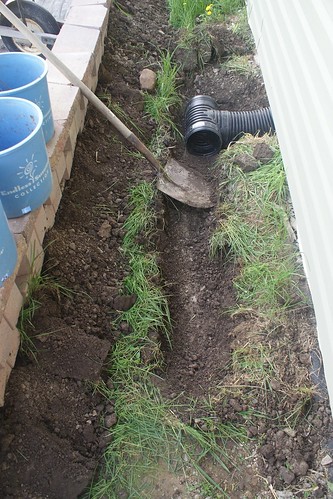
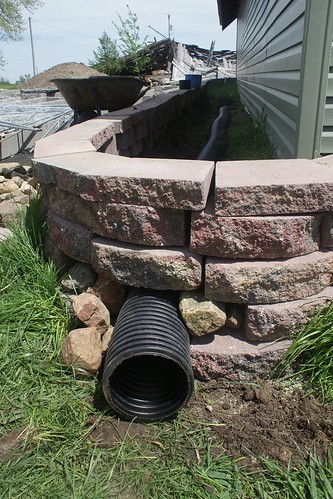


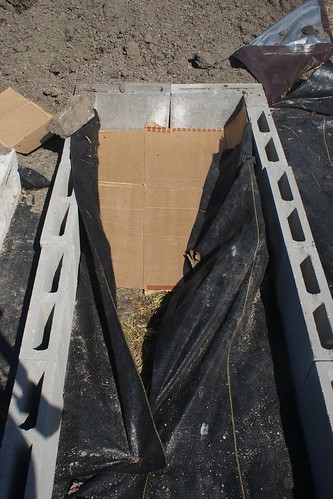
I kept digging a trench, slowly grading up from the low spot where the tube enters the building.  By the time it met the farthest point of the raised bed, it needed to be at ground level to avoid taking in water during rains.  I took down a few sections of the raised bed, and got the tube situated.  I cut it off long, unsure of exactly how much tube I wanted sticking out.  I can trim it later.


Some creative stone work to fill in some gaps and some retaining wall re-assembly, and we had ourselves an installed tube!  I need to find or fabricate some form of grate cap for the end to keep my new air tube from becoming a high-traffic tunnel for critters (especially in the colder months when a warm building is oh-so enticing).

I am encouraged thus far, as the building is sucking air in through the hole around the tube at a noticeable rate.  I'm hoping it will do the same through the tubes once I get that hole back-filled and sealed.

I also thought it would be a good time to dig the post-holes on either end of the west-facing door that will serve as the structural supports for our forthcoming trellis/pergola/awning thing (I didn't want to have to dig the dirt back out of the beds once I'd filled it in).

The trellis/pergola/awning thing will not only look neat and provide some shade over the west doorway, but will also provide a venue for climbing vining plants like grapes or wisteria.  It will also give me something solid to latch the door to when it's open so it's not blowing shut all the cussing time.
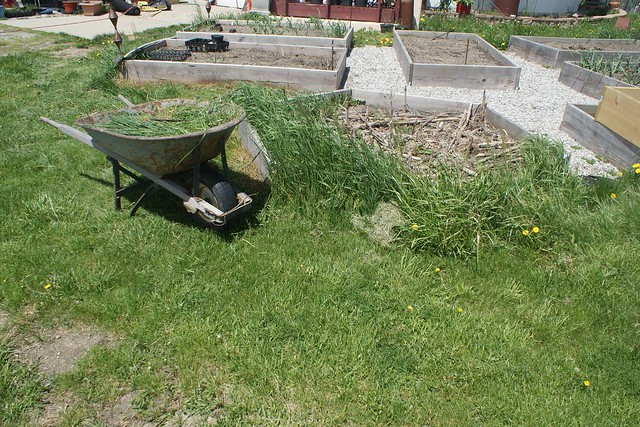
Spent the rest of the day preparing to extend our annual raised bed area, chopping back quack grass from around (and unfortunately, within) some of our beds who have a side that touches lawn.  Important lesson here when it comes to raised beds.... always make sure you have a border of grass-suppressant (lanscape fabric, gravel, something) all the way around your beds... otherwise the grass will just hop under the bed walls and go to town in the soil inside.  If I had a dollar for every worming little white root I fished out of the dirt today... ugh.


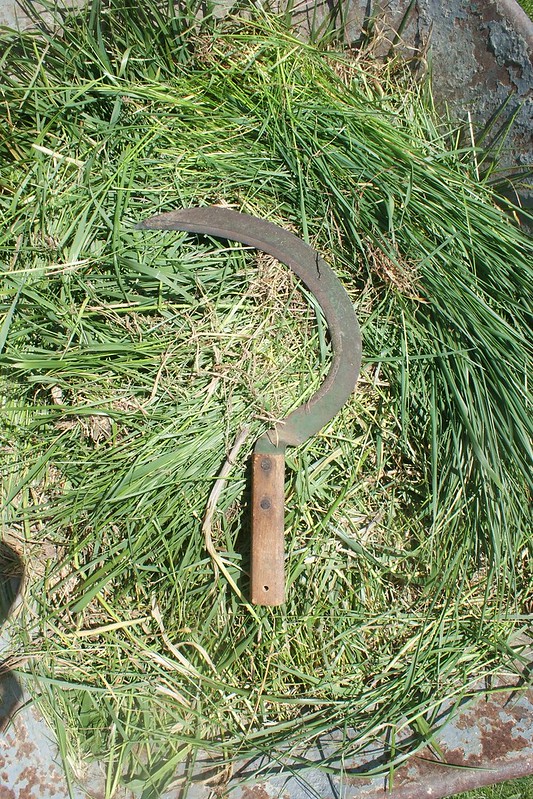
This did mean that I got to make some good use of my new hand sickle today... old but practically brand new, I picked it up at the local flea market for $2.50.  Sharp enough to dig deep into the wood of the raised bed when I miscalculated my swing.  Vanquished a lot of grass out today with that thing....

Friday, May 3, 2013

Apples and pears in bloom!

Stepped out this morning to find several of our apple trees (Blushing Golden and a few crab apples) and some asian pears in full spectacular bloom.


Sunday, April 14, 2013

Spring chores and planting out the nut orchard/woodlot....


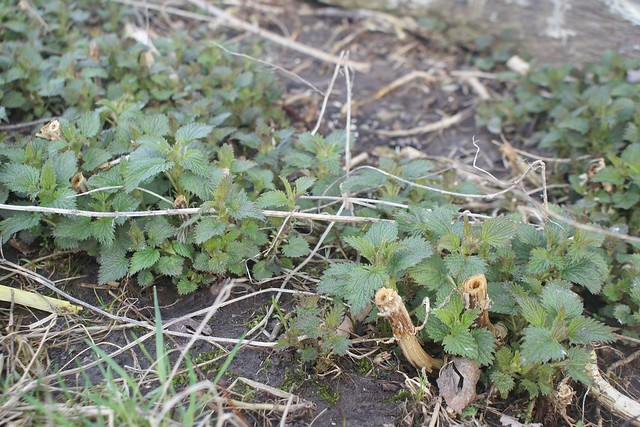
Did some general cleanup around the farm first thing this morning, while I waited for our neighbor up the road to swing by with her parents and take some barn wood for a chicken coop she's building.  I cleaned the old canes out of the stinging nettle patches.  They're just starting to poke out their first growth.  Can't wait to start harvesting for cooking/tea.  I'm sure not too many people enjoy cultivating them as much as we do.  We cherish them as a no-fuss, no-maintenance, delicious and nutrient-dense  addition to our spring diet.


And now that spring is arriving, some of our earliest fruit trees are starting to bloom.  Our Galaxy Peach tree by the driveway is about half-bloomed, and I even spied some honeybees attending to the flowers today.  Not much besides our maple trees are blooming out here yet, I imagine they are taking what they can get... soon enough there will be an endless bounty for them.

Our neighbor and her folks showed up around 10am, and spent the better part of three hours selectively pulling wood off the barn wreckage.  They moved more than they took, and you can hardly tell there's any missing.

I spent the better part of the day out in the field, planting chestnut and black locust seedlings.  This is the perfect time of year for such a task, before the field becomes an impenetrable riot of switchgrass and field weeds, and the clouds of mosquitoes swell to semi-biblical proportions even during the hottest part of the day.  Today there was only the crunch of last year's brittle growth under foot.

Having received approximately no human attention for the better part of fifteen or twenty years, the soil in the field has benefited from the constant cycle of growth and decay playing out along it's surface.  It is still somewhat clay-heavy in spots, but driving a spade into the ground most anywhere produces earth that is dark and crumbly and absolutely loaded with worms and their casings.  Still, I'm hedging my bets by planting the chestnuts in the best-draining areas only.

About half of the chestnuts I bought are only 1-2 year old seedlings, and are looking a bit wimpy to plant out in the field at their small size.  I may pot them up near the house and grow them a bit before transplanting them.

Total tally for the day was a total of seventeen trees planted... six Silverleaf Chestnuts and eleven Black Locust seedlings.  I took special care with the chestnuts, clearing a large three-foot-square area and covering it with landscaping fabric and mulch.  Every tree got a Tubex tree tube, to speed growth and because the rabbits and deer are always hungry.

Spent the last portion of the day removing the failed grape trellis that runs behind the house.  The grapes (which are always described as being carefree and easy to grow) languished since day one... I think they were in soil that was too heavy, with not enough water and too many insects (Japanese Beetles especially) that enjoyed munching on them.  A few of the larger specimens might end up in the plant hospital depending on how they bud out, but most aren't even worth saving.

We're thinking that when we try a mass-planting of grapes again, we're going to plan it out better first this time... finding the right grapes and putting them in the right location.  Novel idea, huh?  Ah well, this is how we learn...


Saturday, April 13, 2013

Chestnut orchard layout, even more raised beds, and accidental garlic...

After coffee and a few pieces of Leah's excellent banana bread, I pulled on my muck boots and waded out into our very skooshy farm.  We've had significant amounts of rain over the past few days (finally!) and the soil in the field is pretty waterlogged.

I drove some T-posts to mark out the locations of soon-to-be-planted trees, along the better-drained and less consistently marshy eastern edge of our fallow field.  This year I'll be putting in between ten and twenty blight-resistant chestnut trees (about five different varieties), interplanted with black locust seedlings.  The goal is to begin converting this portion of our field towards a more productive and diverse forest area that will one day provide us with food and timber.

All the plants in the area are loving the moisture and have seemingly sprung to life overnight.  The grass which looked patchy and very dormant as recently as a week ago now looks like it might need mowing soon (ugh).

We've been reading Gene Logsdon's Living at Nature's Pace: Farming and the American Dream this month for our Meetup group's book club, and it's got me reminding myself of the importance of being constantly aware of and an expert on one's own place, down to every seemingly mundane detail.

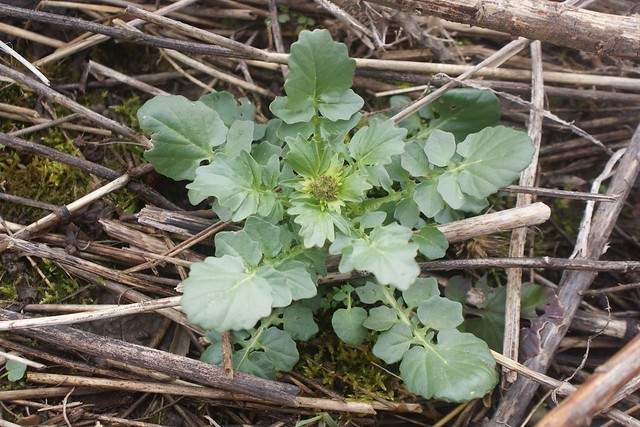
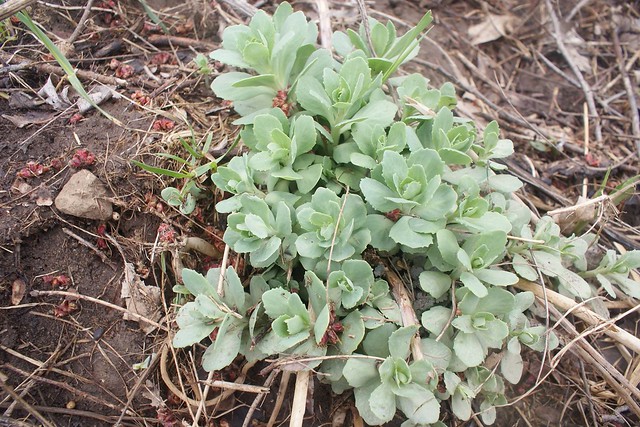
So amongst the moss and wet and mouldering remnants of last year's growth (and the ever more ubiquitous spiked rosettes of teasel), I spotted a few plants I was unfamiliar with:

After some research, I'm pretty sure this is some kind of cress.  The closest ID I could find was Early Winter Cress, but I'm still not 100% sure.  I'd like to be sure before I try nibbling on it.  But I want to.  Because I love cress.

Leah also noticed some type of volunteer sedum growing down by the swale on one of the piles where I've dumped potentially live plant material that I didn't want gaining a foothold in our compost piles.  We've found some similar looking plants on Google image search, but are also finding them identified (potentially mis-identified) as various different species of sedum.


We're discussing rescuing it from the unruly riot that is our woods edge down by the swale and giving it a more dignified home in a pot up near the house.  It certainly is lovely looking.

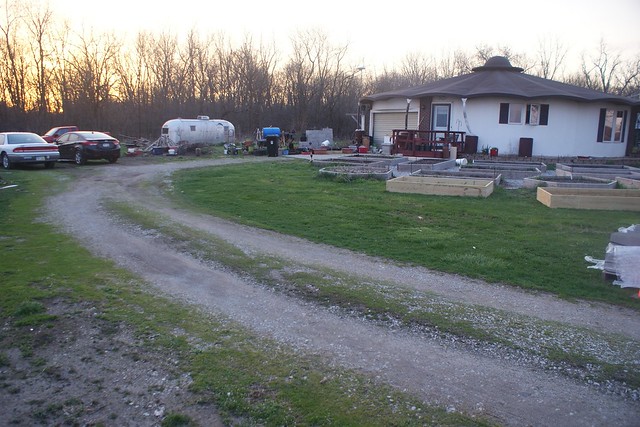
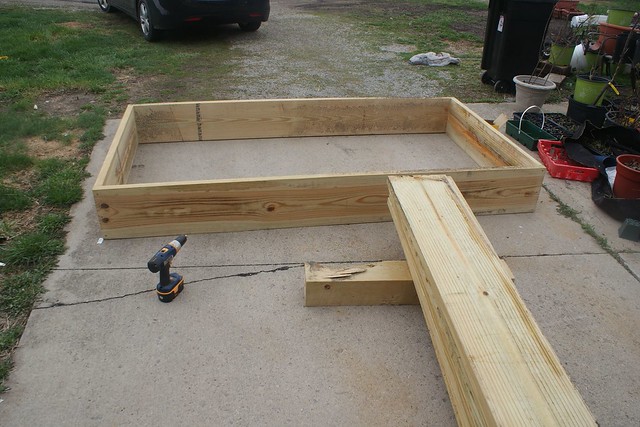
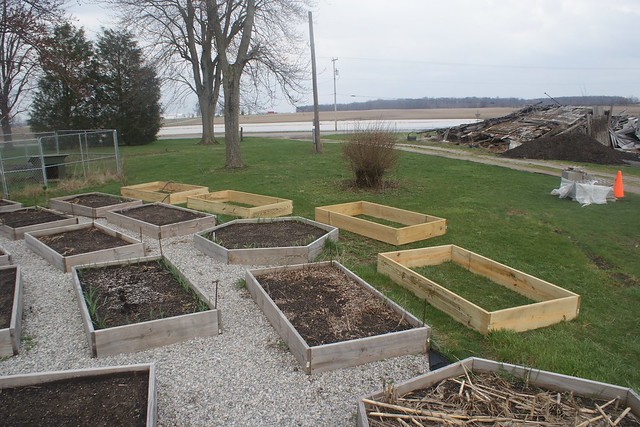
We've been planning to expand our existing Zone 1 raised bed area that we use for more intensive cultivation of annuals along the southeast side of the house.  We've had the lumber sitting around for a while, but I just got around to drilling and screwing the beds together today.


I assembled four 4'x8'x12" beds, and Leah and I tried some different placements to see what looked best.  We're gonna let them sit for a bit and see how it looks from different angles before we extend the fabric/gravel and formally install them.


If you look closely in the picture above, you can see little sprigs of green around the interior edge of our raised beds... that's our garlic, dutifully performing it's duties as one of spring's tastiest ephemerals.

Speaking of garlic, we've had some garlic bulbs that we missed in last fall's "hasty harvest" sprout up bunches of greens at the same time as their more fastidiously harvested/stored/replanted brethren, and this has me thinking....

Leah reminded me that some people just leave the garlic in the soil year-round rather than harvesting it in summer and then replanting later in fall.  I'm not sure what the advantages/disadvantages to this method, but I carefully dug up,  separated and replanted our "forgotten" shoots at wider intervals.  We'll see how they fare in relation to the cloves we planted in the fall.  A garlic experiment!  For science!

Monday, April 8, 2013

Seattle to Install Public Seven Acre Food Forest


I am excited and gladdened to see this NPR feature discussing the creation of a permaculture-designed, free-to-forage public food forest in metro Seattle.  From the piece:
The idea is to give members of the working-class neighborhood of Beacon Hill the chance to pick plants scattered throughout the park – dubbed the Beacon Food Forest. It will feature fruit-bearing perennials — apples, pears, plums, grapes, blueberries, raspberries and more. Herlihy and a team first assembled their vision of a food forest in 2009 as a final project for a permaculture design class.
The project appears to be funded by a combination of public and private donations, including the land the park is to be situated on (donated by a local utility).

In an era in which so much land sits vacant and unused, most especially in areas which could greatly benefit from a local source of fresh, nutrient-dense food, this type of project should serve as a model to communities everywhere.

Sunday, April 7, 2013

Here Comes the Dirt!


We had the benefit of some beautiful, truly spring-like weather this weekend, and tried hard to utilize it.

I spent saturday doing mostly cleanup work... removing an old flower barrel out by the road, leveling out some old flowerbeds and relocating some poorly planned tree/shrub plantings that annually became weedy eyesores and made mowing (even) more difficult.  I even spread some grass seed in the disturbed areas (but oh, how it pains me to actively plant the cursed stuff).  The overall effect will be to smooth out and clean up the look of the frontage quite a bit, and make mowing the area more efficient.

We had 20 cubic yards of soil delivered on Saturday morning, and thankfully the driver was able to land it right next to/kinda on-top-of the beds we'll be filling.  As I've learned, the less long-distance trips you have to make in the sun with a wheelbarrow full of soil, the better.

The landscaping fabric hasn't been down long enough to fully kill the grass, so for the beds that we're filling/planting first, I'm laying down cardboard under the soil to finish off the turf.

We cut and pulled back the landscaping fabric, laid the cardboard, and filled the beds with soil. Once the cardboard deteriorates, the soil in the beds will be in direct contact with the soil beneath.

We planted our first direct-seeded crops tonight as well, seeding one of the two beds we filled... a double row of Sugar Sprint snap peas, two rows of German Giant radishes, and a row of turnips.

We took a break for a few hours out to go take Heidi on a walk around the park in Richwood, and got some ice cream.  We also scored some more cardboard from the recycle-dumpster in town.

At the rate we're going, a few more solid work days and we should have the new garden beds filled and planted.


Wednesday, April 3, 2013

New Trees Get Temporary Garage Vacation


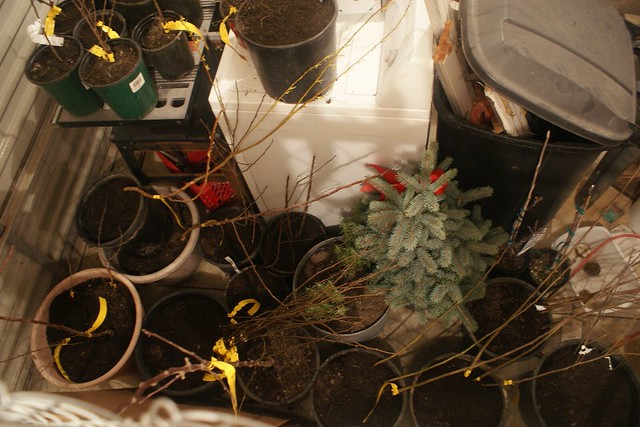
The bulk of our new trees/shrubs showed up in a box from Burnt Ridge Nursery on Monday.  We're not quite ready to start planting them en masse, but I wanted to get them out of the box and into some soil (the nursery standard "throw some wet newspapers in the box to keep the roots moist" trick can go awry rather quickly in a small enclosed airspace).

So after getting home last night, I spent half an hour madly trying to get them all toed in/potted before the sun went down.  Some of them had already started leafing out, which would be bad news if they got left outside for a hard freeze.

So now the front end of our garage is positively crammed with semi-dormant baby trees and shrubs!

Tuesday, April 2, 2013

First seed sprouts and more indoor seed starting.


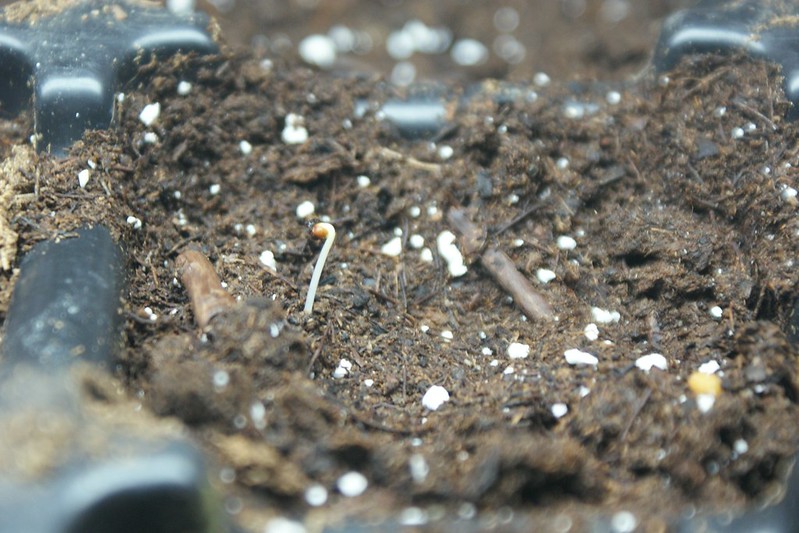
Behold!  Our first indoor-seeded sprout of the 2013 growing season.  This is one of the collards we seeded last weekend, that's been germinating away on a rack in the relatively cool temps of our guest room.  Several other cells of collards have popped as well.  Nothing yet on the cabbage or leeks.

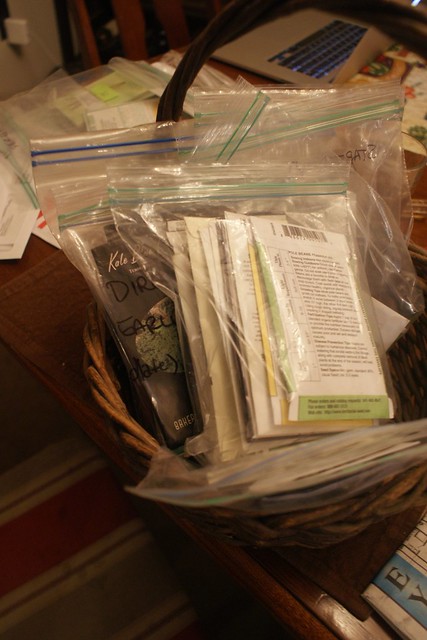
Having received our seedling heat mats in the mail the week before, and with our seeds neatly organized (as only Leah can), we set off last night to get our second round of seeds started indoors.

We planted tomatoes, peppers, and some perennial herbs.  Also, for the first time, we're trying to grow some Thai Red Roselle.

We got our heat mats situated in the grow rack I built several years ago, with LED grow lights.  We situated it in the guest bathroom to keep it the pets out of it while the seeds do their business.

At the moment, the forecast is calling for warmer temps for the rest of this week, so we just might have a nice outdoor working weekend coming up.  Which is good, as the bulk of our new trees/shrubs/perennials just showed up in a big box from Burnt Ridge Nursery.

We are quickly approaching the time of year where the amount of things that need to be done easily and constantly outpaces the time I have to do them.  It feels a bit like being at the highest point on a roller coaster, right before it drops.

I need to call our gravel supplier and see if their crusher is back up and running.  I need to call our soil supplier and see about getting another ungodly huge pile of soil delivered.  I need to do about a billion things, actually, so maybe I'd better start by making a list...


Friday, March 29, 2013

Farm Science in the News 03/29/13

A couple of really neat pieces of news came out recently that may be of interest to the knowledge-thirsty home gardener.

Firstly, research done in Canada shows that plants that are "siblings" don't aggressively compete for resources with each other, and may actually cooperate to some degree... resulting in healthier individuals and a more developed fungal network between them.

This makes sense from a viewpoint of genetic self-interest.  The plants want to see their own genes continue on into the world, even moreso than just their own species.

The implications of this for the home gardener, and especially the seed saver are obvious.  Someone who actively selects for healthier plants and saves seeds from year to year is much more likely to be growing plants that are "related" than someone who buys a new packet of seeds from the store each year.  From the plants' perspective, it means your garden each year will be more like a family reunion and less like a train station full of strangers.

Secondly, NPR reports some interesting news about a recent scientific study done on the quantity and variety of bacteria that live on the surface of the plants we most like to eat.  From the article:
It turns out the invisible communities living on our food vary greatly, depending on the type and whether it's conventional or organic. 
Mung bean sprouts, for one, harbor very different bacteria than alfalfa sprouts. Grapes, apples and peaches house a greater variety of bacteria than veggies. And mushrooms are living in a microbial room of their own, sharing very few bacteria with the other foods tested. 
That's quite different from strawberries, tomatoes and spinach. They had similar surface bacteria, with most coming from one family, the Enterobacteriaceae. That family includes E. coli but many, many other harmless and perhaps beneficial bacteria, too. Enterobacteriaceae was also the most common family, accounting for about one-third of all the microbes overall. 
The good news: Most of the bacterial horde is benign.
That last sentence may be one of my favorite from any news story, ever.

And last (but potentially most importantly), scientists are beginning to unravel some of the myriad ways that a commonly used class of pesticides negatively impact bees and other crucial pollinating insects.  From the article:

Bees are crucial pollinators for much of the world’s food supply. And even low doses of these pesticides – called neonicotinoids – have been linked to a sharp decline in bee reproduction. 
Now a new study seems to have found out why: the pesticides seem to make bees forget the smell of food.
Neonicotinoids (a mouthful, I know) are a widely-used in the US, Canada and Europe.  There is currently a lawsuit in progress against the EPA in an attempt to ban them in the US.

Sunday, March 24, 2013

Revising the Long Beds (Day 3) and Misc. Sunday Work

Bleary weather returned today, blech.  But we started off our Sunday the best way we know how... by going to an all-you-can-eat pancake breakfast!  Our local (just down the road on the way into town) Fire Department was having one as a fundraiser, with the pancakes made by Chris Cakes (he throws them to/at you).  Also ran into our ex-next door neighbors.  He's a volunteer firefighter there and they're awesome folks.

While we ate, we game-planned an idea Leah had come up with regarding a potential alteration to the long bed plan... namely that of opening an aisle down the middle of the rows, in effect making 8 rows instead of 4.  We discussed the addition of some sort of arched trellis or pergola over the gap between rows to create a nice focus for the garden area and better access to the beds.  We agreed that this was a good idea.

Wanting to keep on-schedule with our garden this year (which might actually be possible without the greenhouse construction hanging over our heads), we also started our first seeds indoors today.


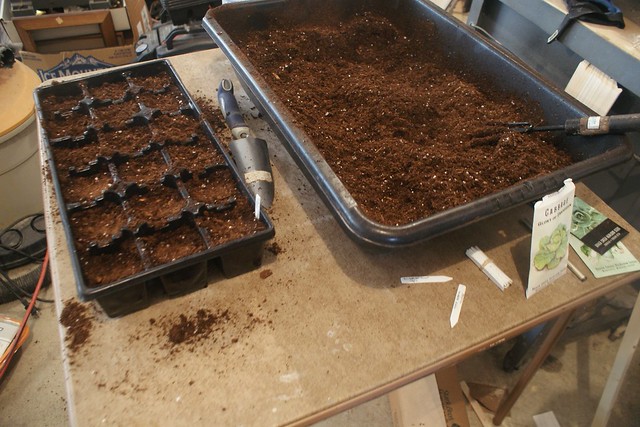
We seeded cabbage, collards and leeks, and set them up under some grow lights in the garage where temperatures will hopefully be in the correct range for them to germinate.

I went out and made quick work of making our aisle down the middle of our long beds.


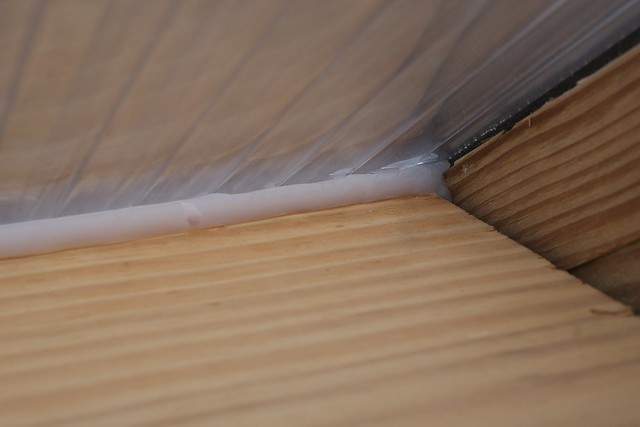
Also did some more weather sealing in the greenhouse... filling more gaps with Great Stuff and sealing the areas where the polycarbonate panels meet our windowsills with silicone caulk.  Due to the extreme angle produced by the sill and panel, I had to modify each caulk tube by taping a piece of tubing to extend the nozzle.  This worked like a charm to get the caulk where it needed to go, but unfortunately it meant I couldn't use my Ryobi 18v Power Caulker (one of the best tools ever... I'll do a post one day on how awesome it is) and now my wrists are busted.  But my greenhouse is more airtight than it used to be!


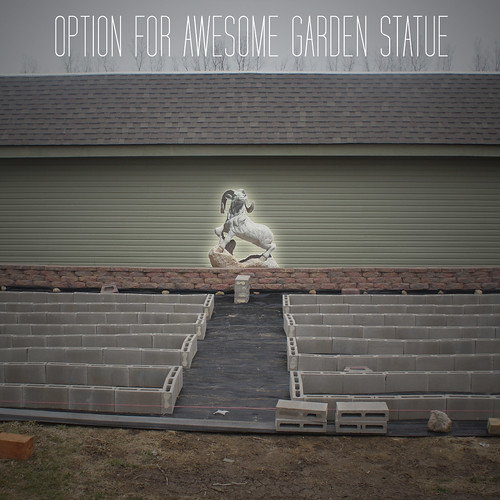
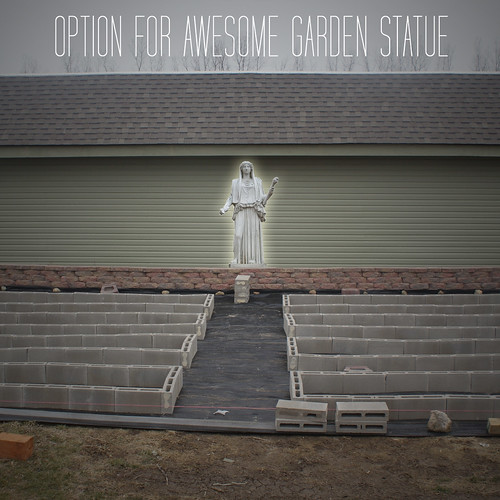
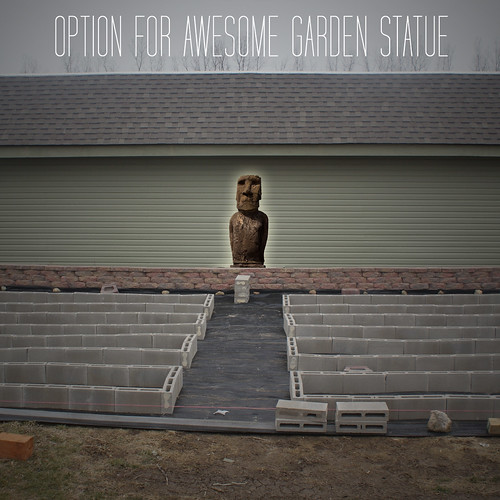
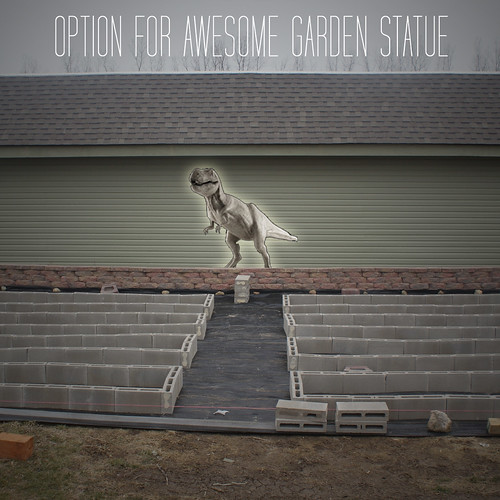
Leah and I also discussed adding a visual feature in the raised bed along the greenhouse where our new aisle ends.  We both think this could be really awesome.  I've done a little photoshopping below to illustrate a few examples of how awesome this could be, exactly.  My favorite is the last one, for obvious reasons.